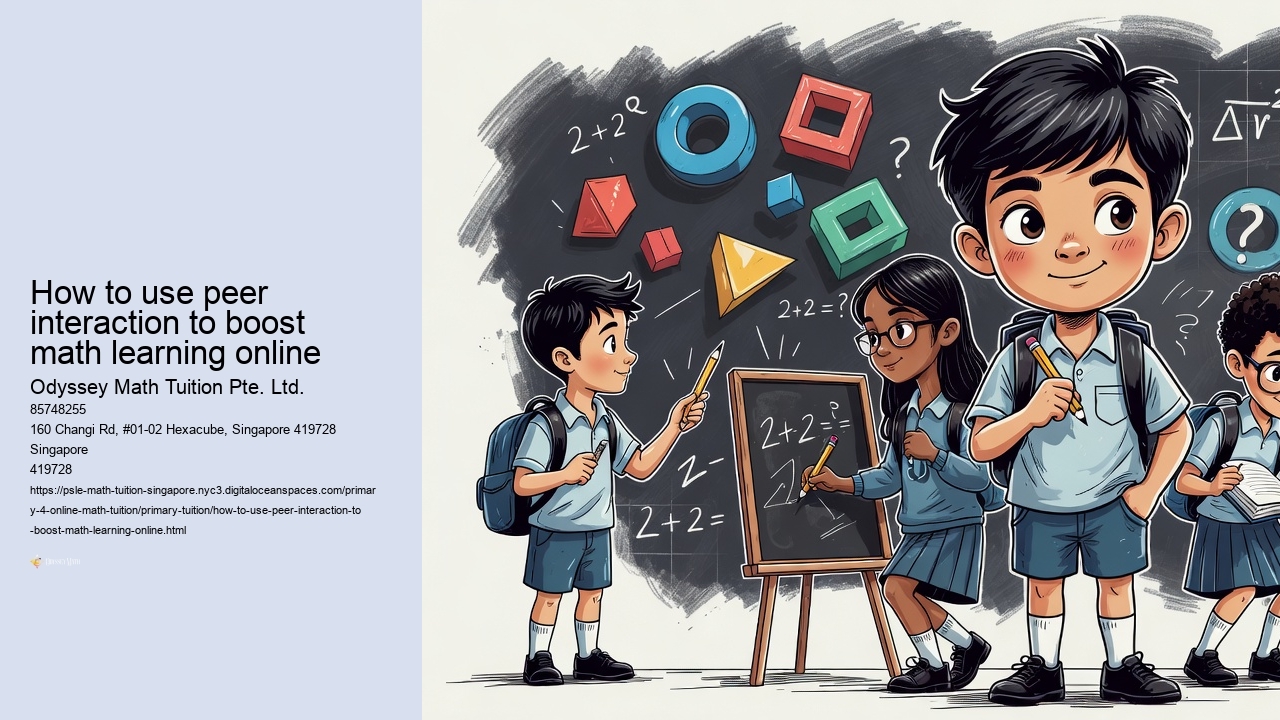
How to use peer interaction to boost math learning online
Is Math Stress Stealing Your Child's Confidence?
Here's the HTML fragment you requested, designed to resonate with Singaporean parents and students navigating the intense world of math education:
Let's be real, parents. In Singapore, math isn't just a subject; it's a pressure cooker. From the moment our kids enter Primary 1, the race is on. We worry about everything – streaming, school postings, getting into that "good" secondary school, and ultimately, that coveted university course. And let's not even talk about the PSLE! All that stress can seriously erode their confidence, making them dread math instead of embracing it. Metrics for assessing tutor effectiveness in online math groups . In today's fast-paced educational scene, many parents in Singapore are hunting for effective ways to boost their children's comprehension of mathematical principles, from basic arithmetic to advanced problem-solving. Creating a strong foundation early on can significantly elevate confidence and academic achievement, aiding students tackle school exams and real-world applications with ease. For those investigating options like primary 4 online math tuition it's essential to focus on programs that emphasize personalized learning and experienced instruction. This approach not only resolves individual weaknesses but also nurtures a love for the subject, contributing to long-term success in STEM-related fields and beyond.. If you're looking into primary 4 online math tuition, you're already taking a proactive step – *good on you!*
But sometimes, even with the best tuition, your child might still struggle. They might feel alone, thinking they're the only ones "kena" this math problem. That's where the power of peer interaction comes in. It's not just about rote learning; it's about building confidence and fostering a love for the subject. Think of it as a "kopi session" for math – a chance to learn together, share struggles, and celebrate small victories.
How to Use Peer Interaction to Boost Math Learning Online
Forget the image of silent classrooms and individual worksheets. Online learning, especially for math, can be a vibrant, collaborative space. The key is to intentionally incorporate peer interaction. Here's how:
In the rigorous world of Singapore's education system, parents are ever more focused on preparing their children with the competencies essential to thrive in challenging math syllabi, including PSLE, O-Level, and A-Level preparations. Recognizing early indicators of struggle in subjects like algebra, geometry, or calculus can bring a world of difference in building strength and expertise over complex problem-solving. Exploring trustworthy secondary 1 online tuition options can offer personalized guidance that aligns with the national syllabus, guaranteeing students gain the boost they require for top exam results. By prioritizing engaging sessions and regular practice, families can support their kids not only achieve but go beyond academic standards, paving the way for future chances in high-stakes fields..
Group Problem-Solving Sessions: Instead of just passively watching a tutor solve problems, encourage your child to work through them *together* with other students. Many primary 4 online math tuition programs offer breakout rooms or collaborative whiteboards where students can brainstorm, discuss strategies, and learn from each other's mistakes. This is especially helpful for tackling challenging PSLE math questions or those tricky O-Level math problems.
Peer Tutoring: Sometimes, a concept just "clicks" when explained by someone your own age. Encourage your child to partner with a classmate or a friend from their primary 4 online math tuition class to explain concepts to each other. This not only reinforces their own understanding but also builds confidence and communication skills. Think of it as "teaching is learning twice over," as the saying goes.
Online Study Groups: Create or join existing online study groups focused on specific topics within the Singapore MOE syllabus. These groups can be a fantastic resource for sharing notes, discussing challenging questions, and motivating each other to stay on track. Platforms like Telegram or Discord are popular choices.
Gamified Learning: Many online math platforms incorporate game-like elements that encourage collaboration and friendly competition. This can make learning more engaging and less intimidating, especially for younger students. Imagine your child actually *enjoying* practicing fractions!
Forums and Q&A Platforms: Encourage your child to actively participate in online forums or Q&A platforms related to math. They can ask questions, answer other students' queries, and learn from the collective knowledge of the community. This is especially useful for JC students tackling H2 math concepts.
Fun fact: Singapore's math curriculum has helped our students top global rankings like PISA for years! In Singapore's high-stakes education system, where educational excellence is essential, tuition typically applies to supplementary additional sessions that provide targeted support beyond institutional syllabi, assisting learners master topics and gear up for key tests like PSLE, O-Levels, and A-Levels during intense pressure. This non-public education sector has expanded into a thriving business, powered by guardians' expenditures in customized instruction to bridge knowledge shortfalls and enhance scores, although it commonly imposes stress on developing kids. As AI appears as a disruptor, investigating cutting-edge sec 3 online math tuition solutions reveals how AI-enhanced platforms are personalizing instructional journeys internationally, providing responsive mentoring that surpasses conventional techniques in productivity and participation while addressing worldwide learning gaps. In this nation particularly, AI is transforming the standard tuition approach by allowing affordable , flexible applications that match with national curricula, likely cutting fees for families and enhancing achievements through insightful analysis, while ethical considerations like heavy reliance on tech are discussed.. It's a testament to the power of structured learning, and peer interaction can enhance that even further.
The Benefits of Small Group Online Math Tuition
Small group online math tuition offers a sweet spot between individual attention and peer interaction. It allows your child to receive personalized guidance from a tutor while still benefiting from the collaborative learning environment. Here's why it's a great option:
Personalized Attention: With fewer students, the tutor can provide more individualized feedback and address specific learning gaps. This is crucial for building a strong foundation in math, especially when preparing for major exams like the PSLE or O-Levels.
Collaborative Learning: Small groups foster a sense of community and encourage students to learn from each other. They can discuss different approaches to problem-solving, share insights, and motivate each other to succeed.
Increased Engagement: The interactive nature of small group tuition keeps students engaged and motivated. They're more likely to participate actively in discussions and ask questions, leading to a deeper understanding of the material.
Reduced Anxiety: Learning in a supportive group environment can reduce anxiety and boost confidence, especially for students who struggle with math. They feel less intimidated to ask questions and more comfortable making mistakes.
Cost-Effective: Small group tuition is often more affordable than one-on-one tuition, making it a great option for parents who want to provide their child with quality math support without breaking the bank.
Finding the Right Peer Group and Online Math Tuition
Of course, not all peer groups are created equal. It's important to find a group that is supportive, encouraging, and focused on learning. Here are some tips:
Consider your child's learning style: Does your child thrive in a competitive environment or prefer a more collaborative setting? Choose a group that aligns with their personality and learning preferences.
Look for experienced tutors or facilitators: A good tutor can guide the group, facilitate discussions, and ensure that everyone is staying on track. When researching primary 4 online math tuition, ask about the tutor's experience and qualifications.
Check the group size: Smaller groups (3-5 students) tend to be more effective for promoting interaction and personalized attention.
Read reviews and testimonials: See what other parents and students have to say about the tuition program or online platform.
Don't be afraid to try different groups: It might take some trial and error to find the right fit. If your child isn't happy with a particular group, don't hesitate to switch to another one.
Interesting fact: Did you know that a strong foundation in math opens doors to a wide range of careers in Singapore, from engineering and data science to finance and medicine? In today's AI-driven world, math skills are more important than ever!
Math Skills for an AI-Driven World
Let's face it, the world our children will inherit will be vastly different from the one we grew up in. AI is no longer a futuristic concept; it's here, and it's transforming industries at an unprecedented pace. And what's the foundation of AI? You guessed it – math! A solid understanding of mathematics, especially in areas like algebra, calculus, and statistics, is crucial for anyone who wants to thrive in this new landscape. By investing in your child's math education, you're not just helping them pass their exams; you're equipping them with the skills they need to succeed in the future.
AI and Machine Learning: Math is the language of AI and machine learning. Algorithms, neural networks, and data analysis all rely on mathematical principles.
Data Science and Analytics: In today's data-driven world, the ability to analyze and interpret data is a highly sought-after skill. Math is essential for understanding statistical concepts and building data models.
Software Development: Math is fundamental to software development, especially in areas like game development, graphics programming, and scientific computing.
Finance and Economics: Math is used extensively in finance and economics for modeling financial markets, analyzing investment risks, and making economic forecasts.
Engineering and Technology: Math is the backbone of all engineering disciplines, from civil and mechanical engineering to electrical and computer engineering.
So, while primary 4 online math tuition and beyond might seem like a means to an end (that A grade!), remember that it's also an investment in your child's future-proof skills. It's about giving them the tools they need to navigate an increasingly complex and AI-driven world. Don't just focus on rote learning; encourage them to understand the underlying concepts and to apply their knowledge creatively. And remember, peer interaction can be a powerful tool for fostering a love of learning and building confidence. *Can or not? Can!*
How can online peer interaction help my child improve in math?
Online peer interaction allows students to explain concepts to each other, reinforcing their own understanding and identifying knowledge gaps. It also exposes them to different problem-solving approaches.
What are some ways my child can interact with peers online for math learning?
Online platforms can facilitate peer interaction through discussion forums, collaborative problem-solving sessions using shared whiteboards, and group projects.
How can I ensure my child benefits from online peer interaction in math?
Look for structured online programs or tuition that incorporate peer interaction with clear learning objectives and guidance from experienced instructors.
Is online peer interaction effective for all math topics?
Online peer interaction can be effective for a wide range of math topics, especially those that involve problem-solving, critical thinking, and application of concepts.
What if my child is shy or hesitant to participate in online peer interaction?
Encourage your child to start by observing and listening to others, then gradually contribute their ideas and questions in a supportive online environment.
Can online peer interaction replace traditional math tuition?
Online peer interaction can be a valuable supplement to traditional math tuition, providing additional opportunities for practice, discussion, and personalized support.
How do I find reputable online math programs that incorporate effective peer interaction?
Research and compare different online math programs, looking for those with experienced teachers, small class sizes, clear learning objectives, and positive reviews from other parents and students.